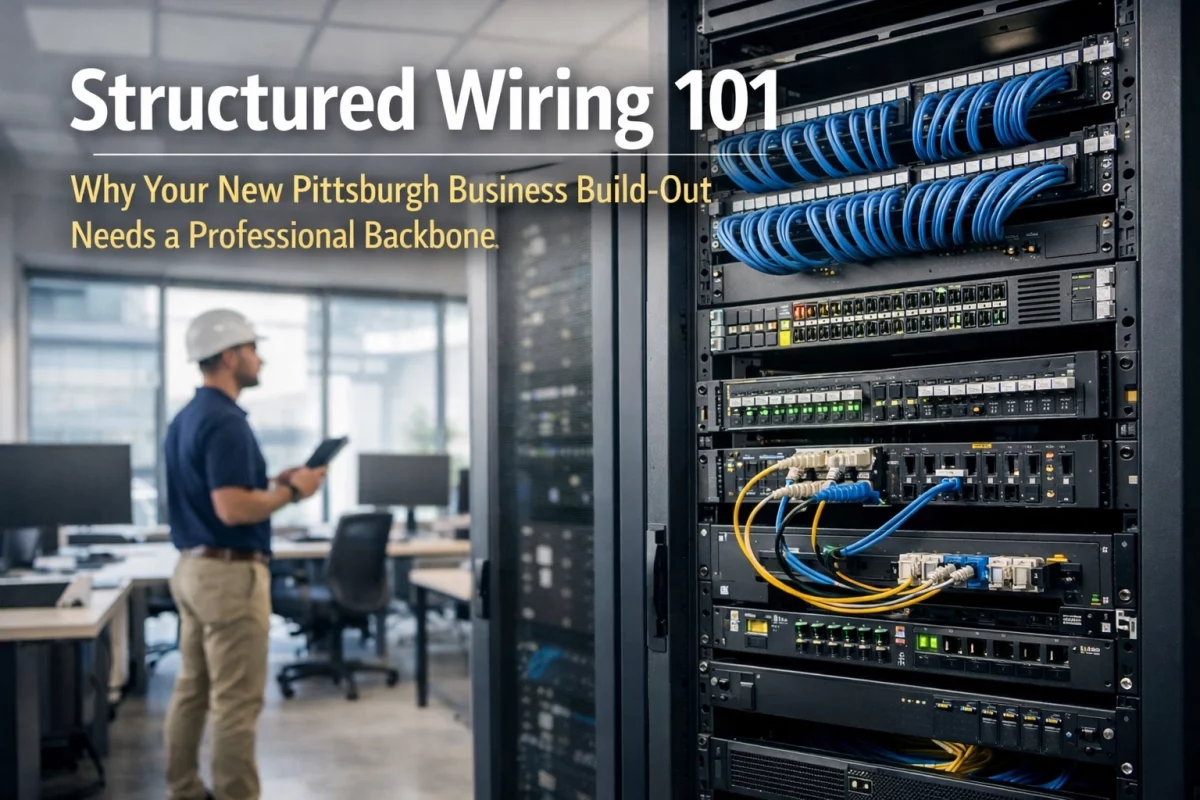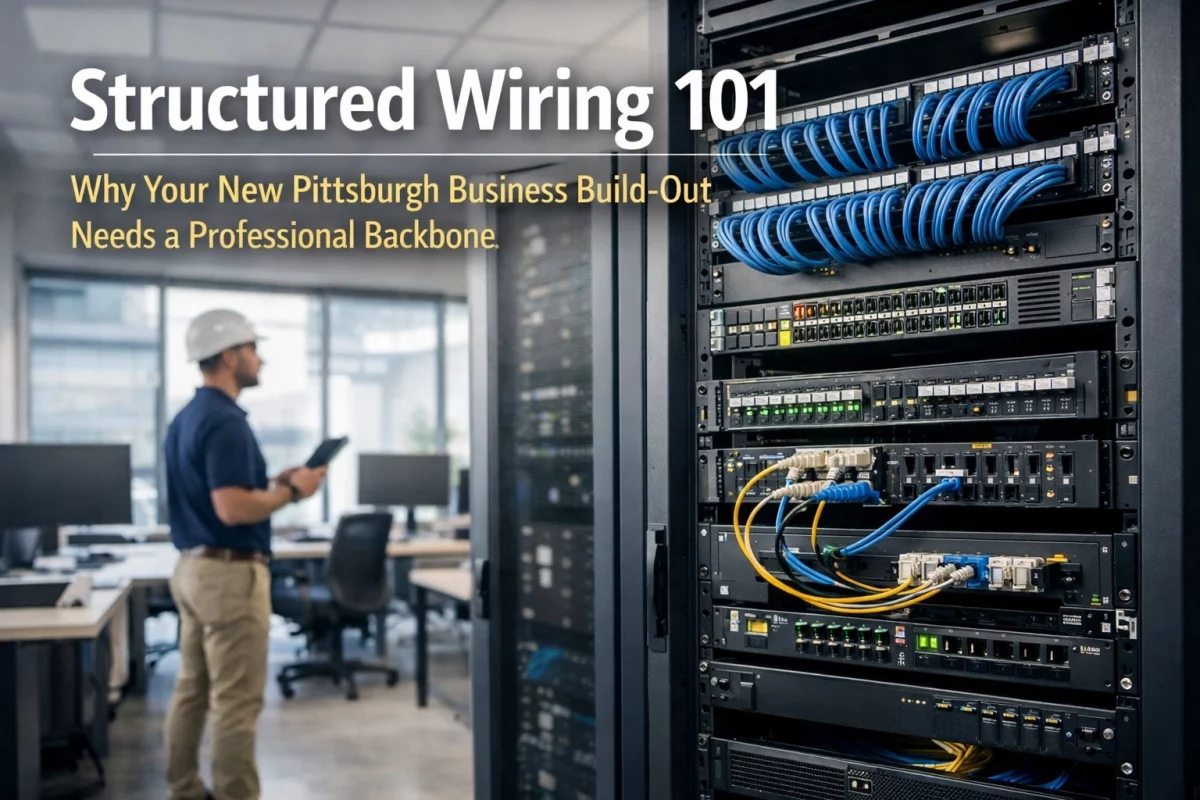
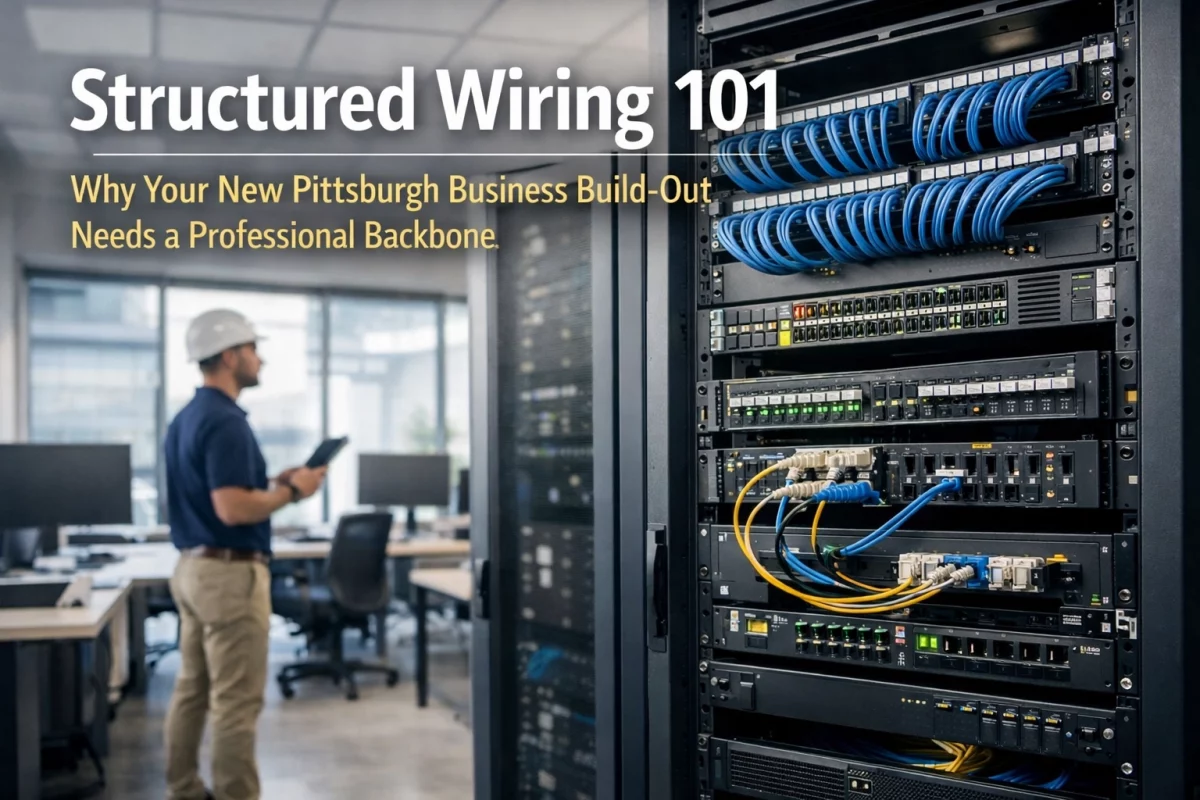
Structured wiring represents the organized cabling infrastructure that supports every piece of technology in your commercial facility. Unlike the tangled mess of cables often found in older buildings, structured cabling creates a unified system connecting voice, data, video, security, and audio systems through a central distribution point.
For Pittsburgh businesses planning new office build-outs, retail spaces, or commercial facilities, this infrastructure backbone determines whether your technology works seamlessly or creates constant headaches. The difference between professional structured cabling and makeshift wiring becomes immediately apparent when you need to troubleshoot issues, add workstations, or scale operations.
Think of structured wiring as the nervous system of your building. Every device, workstation, camera, phone, and access point connects through this organized network of cables, patch panels, and termination points. When designed and installed correctly, this system becomes nearly invisible: technology simply works without constant intervention.

Many business owners view structured cabling as a commodity service where any electrician can pull some cables through walls. This assumption costs businesses thousands in rework, downtime, and lost productivity. Professional structured cabling contractors perform comprehensive site surveys before running a single cable, creating custom-built systems tailored to your specific layout and growth projections.
Expert installation ensures every cable follows proper pathways, maintains appropriate bend radius, avoids interference sources, and terminates according to industry standards. Each connection undergoes testing to verify performance specifications. This attention to detail prevents the intermittent connectivity issues and mysterious network problems that plague poorly installed systems.
Professional contractors also understand building codes, fire ratings, and plenum requirements specific to commercial spaces. They obtain necessary permits, coordinate with other trades, and document the entire installation for future reference. This documentation becomes invaluable when modifications or troubleshooting becomes necessary years after installation.
The upfront investment in professional design and installation prevents costly mistakes and eliminates the need for complete system rework within months of opening your facility. Pittsburgh businesses that cut corners on cabling infrastructure often spend more correcting problems than they would have invested in proper installation initially.
Network downtime directly impacts revenue, employee productivity, and customer experience. Structured cabling systems minimize disruptions through superior organization and reliability. With clearly labeled cables, color-coded connections, and proper documentation, technicians quickly identify and resolve issues without disrupting unaffected areas of your network.
The organized nature of structured cabling means troubleshooting involves checking specific connection points rather than tracing tangled cables through ceilings and walls. When problems occur, technicians reference installation diagrams showing exactly where cables run and how systems connect. This targeted approach reduces mean time to repair from hours to minutes.
Structured systems also withstand daily wear and tear better than ad-hoc installations. Cables run through protective conduits or along designated pathways avoid damage from building maintenance, ceiling tile replacement, or other routine activities. Proper cable management prevents stress on connectors that leads to intermittent failures.
For Pittsburgh businesses where network reliability directly affects operations: retail point-of-sale systems, manufacturing floor controls, healthcare records access: structured cabling provides the foundation for consistent uptime. The system reliability translates directly to business continuity and reduced emergency service calls.

New businesses rarely remain static. Teams grow, departments expand, and floor plans evolve. Structured cabling anticipates this growth by creating a flexible infrastructure that accommodates changes without requiring wall demolition or complete rewiring.
Adding new workstations becomes straightforward with structured cabling. Technicians simply connect new devices to pre-existing wall outlets and patch them through at the central distribution panel. This plug-and-play approach means moves, adds, and changes happen quickly without disrupting existing operations. Employees relocate to different offices without waiting days for network connectivity.
The scalability extends beyond simple workstation additions. Structured cabling supports various system types through the same physical infrastructure. Security cameras, access control panels, VoIP phones, and Wi-Fi access points all connect through the structured backbone. When you decide to upgrade from analog cameras to IP-based surveillance, the cabling infrastructure already supports this transition.
Pittsburgh businesses planning for growth benefit from installing capacity beyond immediate needs. Running additional cables to each location during initial construction costs significantly less than retrofitting later. This forward planning ensures your infrastructure supports business expansion without requiring disruptive renovation projects.
While structured cabling requires higher upfront investment than basic wiring, the long-term cost savings prove substantial. Organized systems reduce maintenance expenses through improved troubleshooting efficiency and fewer service calls. Technicians spend less time diagnosing problems and more time implementing solutions.
Energy costs decrease with proper cable management. Organized cabling allows better airflow in server rooms and telecommunications closets, reducing cooling requirements. Well-managed cables don’t block HVAC vents or create heat pockets that force climate control systems to work harder.
The system’s flexibility reduces costs when making infrastructure changes. Rather than pulling new cables for each modification, technicians reconfigure connections at patch panels. This approach eliminates labor costs for accessing ceilings, drilling walls, and fishing cables through building structures.
Documentation accompanying professional installations provides another cost benefit. Clear records of cable pathways, connection points, and system architecture enable faster troubleshooting and more accurate quotes for future modifications. You’re not paying technicians to map your infrastructure each time work becomes necessary.
Today’s business applications demand reliable, high-speed connectivity. Cloud-based software, video conferencing, VoIP phone systems, and large file transfers all require consistent bandwidth and low latency. Structured cabling using current standards: typically Category 6A or fiber optic cables: provides the performance headroom these applications require.
Professional installations ensure cables maintain proper specifications throughout their length. Improper terminations, excessive cable runs, or proximity to electrical interference sources all degrade network performance. Certified installers test each cable segment to verify it meets performance standards under real-world conditions.
The organized structure also enables network segmentation for security and performance optimization. Different departments, guest networks, and IoT devices operate on separate VLANs while sharing the same physical infrastructure. This separation improves both security and network efficiency by isolating traffic appropriately.
For Pittsburgh businesses implementing advanced security systems, building automation, or high-definition video surveillance, structured cabling provides the necessary bandwidth and reliability. These systems generate significant data traffic that inferior cabling infrastructure simply cannot support consistently.

Technology evolves rapidly, but building infrastructure remains in place for decades. Structured cabling installed according to current standards supports emerging technologies without becoming obsolete. The physical infrastructure accommodates protocol changes, bandwidth increases, and new device types through the same cable pathways.
Installing Category 6A cabling or fiber optic backbones provides significant headroom beyond current requirements. As IoT devices proliferate, wireless access points require faster backhaul, and video applications demand more bandwidth, your infrastructure handles these increases without requiring replacement.
The standardized nature of structured cabling also ensures compatibility with future equipment. Network switches, security systems, and telecommunications equipment from various manufacturers all connect through standard cabling interfaces. You’re not locked into specific vendors or proprietary systems that limit future options.
Pittsburgh businesses investing in new facilities should view structured cabling as a 15-20 year infrastructure decision. Proper installation now prevents the need for disruptive renovations when technology requirements increase. This long-term perspective makes professional structured cabling installation one of the most cost-effective technology investments you can make.
TN Security designs and installs structured cabling systems for commercial facilities throughout Pittsburgh. Our certified technicians perform comprehensive site surveys, create detailed installation plans, and execute implementations that meet or exceed industry standards. Every cable undergoes testing and certification to verify performance specifications.
We coordinate with construction schedules, work alongside other trades, and ensure installations comply with building codes and fire safety requirements. Our documentation provides detailed records of cable pathways, connection points, and system architecture for future reference.
Whether you’re building out new office space, renovating retail locations, or constructing commercial facilities, proper structured cabling creates the foundation for reliable technology operations. Contact TN Security at 412-967-0467 or email sales@teamnutztechnology.com to discuss your project requirements. Visit our offices at 3287 Library Road, Pittsburgh, PA 15234, or learn more at https://www.tnsecuritypittsburgh.com.
Your technology infrastructure deserves the same attention and professionalism as your building’s electrical, plumbing, and HVAC systems. Invest in structured cabling that supports your business operations today while accommodating growth and technological advancement for years to come.